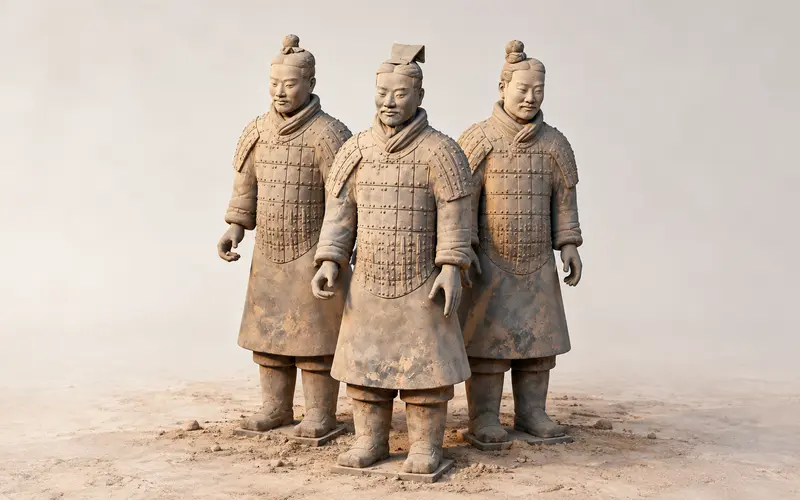
Who Really Made China's Terracotta Army?
Monday, October 26, 2026204 words3 minutes364 reads
For more than 2,200 years, fingerprints have preserved traces of the people who shaped China's Terracotta Army. An October 2026 study in the Journal of Cultural Heritage suggests that its workshops may have included women and children as well as adult men.
Created for Qin Shi Huang near Xi'an, the army contains thousands of clay figures. Production involved shaping separate components and assembling them, allowing several workers to contribute to one soldier. Contact with wet clay left fingerprint ridges that could survive firing.
Researchers examined 79 clear prints on 36 soldiers, analysing the spacing between ridges. This spacing generally increases as children grow, while adult patterns also vary. Because age and sex categories overlap, the team used a statistical model to assess the prints collectively. It attributed approximately 45% to adult men, 33% to adult women, and 22% to children under 15.
These proportions cannot establish the workforce's composition: individuals could leave multiple prints or none. The limited sample and reliance on modern reference data add uncertainty. Ancient records describing young people learning practical skills make children's participation plausible, but fingerprints cannot identify anyone's precise task. The findings nevertheless shift attention from an emperor's monument towards the ordinary people whose labour made it possible.