Almost the Entire Moon Is About to Disappear
Wednesday, August 26, 2026267 words4 minutes3634 reads
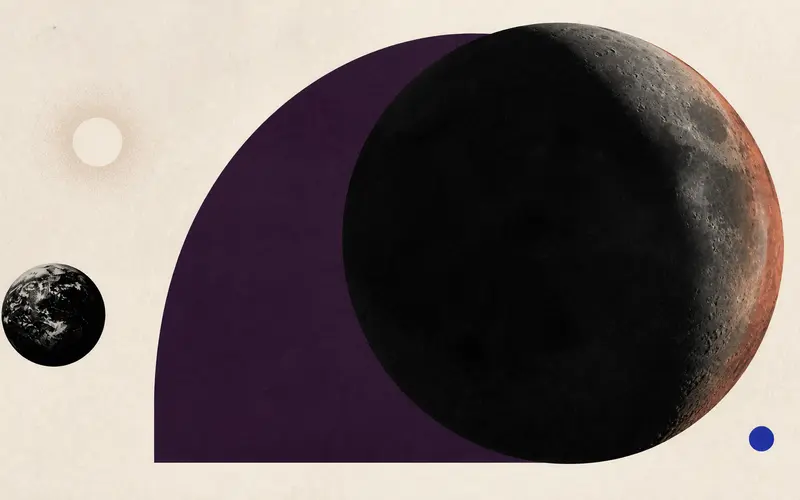
Almost the entire Moon will briefly disappear into Earth's shadow during a deep partial lunar eclipse on August 27–28. At the moment of greatest eclipse, about 96.3% of the lunar disk will lie inside Earth's darkest shadow, known as the umbra.
The eclipse will be visible across the Americas, as well as parts of Europe and Africa. Nearly 1 billion people in the United States, Canada, and Central and South America will be able to follow the full event if local skies are clear. More than 3 billion people may see at least part of it.
A lunar eclipse occurs when Earth passes between the Sun and the Moon. The alignment allows Earth to block direct sunlight and project its shadow onto the Moon. The covered section may appear dark or copper-colored because Earth's atmosphere bends and filters some sunlight toward the lunar surface.
A solar eclipse follows the reverse arrangement: the Moon passes between the Sun and Earth, casting a shadow over a small section of our planet. Because the Moon's shadow on Earth is relatively narrow, total solar eclipses are visible only along a limited path. A lunar eclipse, by contrast, can be seen from much of the entire night side of Earth, making it a far more widely shared event.
The two eclipses this month belong to the same eclipse season, when the Sun, Earth, and Moon can line up closely enough for one body to block light from another. The comparison offers a simple lesson in astronomy: determine which object casts the shadow, and you can understand how large the audience will be.