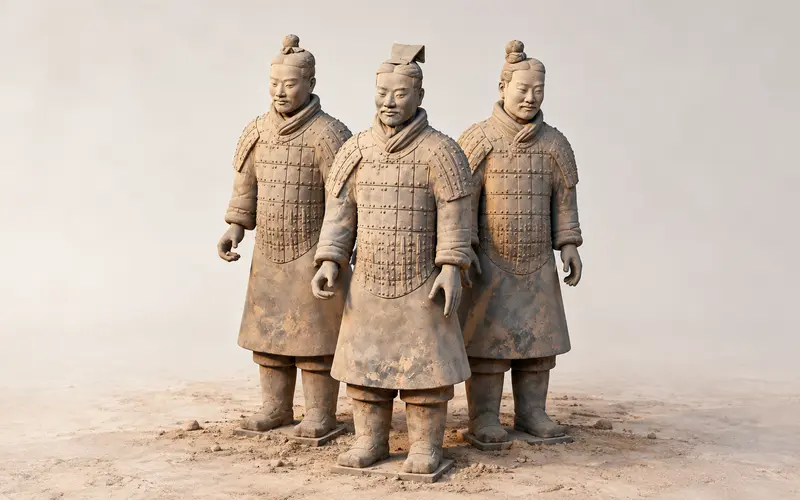
Who Really Made China's Terracotta Army?
Monday, October 26, 2026166 words3 minutes364 reads
A fingerprint left in soft clay can last for thousands of years. Researchers studying China's Terracotta Army suggest that women and children may have helped make the soldiers, alongside adult men.
The army was created for Qin Shi Huang, China's first emperor, near Xi'an. He died in 210 BC. Workers shaped different body parts separately before joining them together. Their fingers sometimes left tiny lines in the wet clay. Heating the figures made many marks permanent.
In an October 2026 study, researchers examined 79 clear fingerprints on 36 soldiers. They measured the spaces between fingerprint lines and used a statistical model. It suggested that about 45% of the prints came from adult men, 33% from adult women, and 22% from children under 15.
These are estimates of prints, not shares of all workers. One person could leave several marks, and the sample was small. The model also relies partly on modern data. The marks cannot reveal each person's task, but they offer clues about ordinary workers.