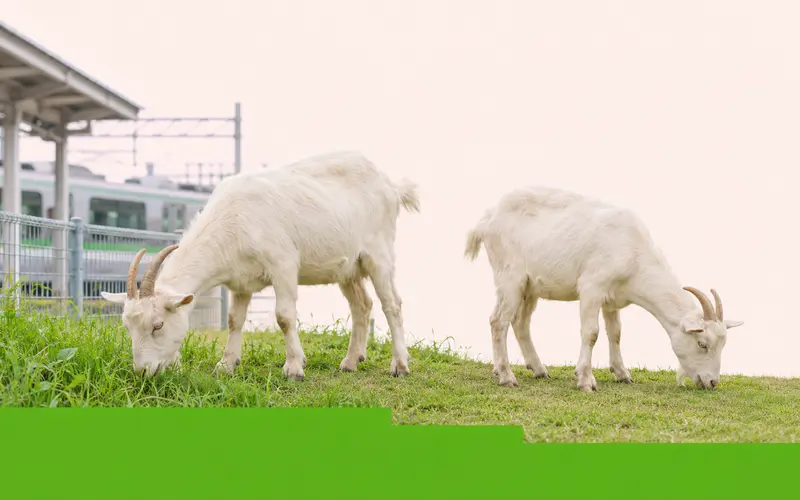
Two Goats Trim Grass at a Tokyo Station
Friday, November 6, 2026209 words3 minutes198 reads
Beside Yotsuya Station in central Tokyo, two goats are turning routine railway maintenance into a public attraction. JR East is testing Nagi and Pokke on approximately 900 square metres of land near the Akasaka exit, where they eat unwanted vegetation instead of leaving the task entirely to machines.
Proposed by a station employee, the trial uses the animals' natural feeding behaviour as an alternative to noisy mowing and chemicals. Students and office workers pause to watch, while photographs circulate on social media. JR East says it has tried similar approaches at other railway sites, but this is its first such project within Tokyo's Yamanote railway loop.
The apparent simplicity conceals continuing responsibilities. Station staff provide water, a small shelter and daily care; the goats also remain on site overnight. Visitors are asked to keep a safe distance. Grazing requires a suitable environment, and the animals cannot be expected to eliminate every unwanted plant.
The experiment therefore offers no automatic proof of financial or environmental benefits: JR East has announced no measured savings in money or energy. Its practical effectiveness remains under assessment. What is already visible is a change in how people experience maintenance: work that usually attracts little attention has become a reason for busy travellers to pause.