China Tests a Mining Robot Over 5,000 Metres Deep
Sunday, November 22, 2026210 words3 minutes1046 reads
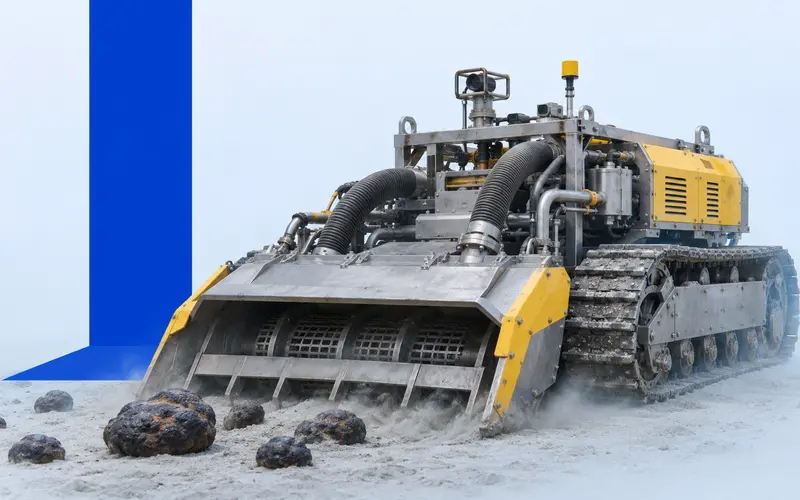
China has tested a robotic collector 5,330 metres beneath the eastern Pacific, demonstrating equipment designed to gather metal-bearing rocks from the seabed. China Minmetals announced the trial in November 2026, reporting sustained operation despite cold conditions, high pressure and soft sediment. This was a collection trial, rather than evidence that a commercial mine had begun operating.
The target deposits are polymetallic nodules, which contain manganese, nickel, cobalt and copper. Their value lies partly in industrial applications, including batteries and electrical equipment. However, a mineral resource is not the same as a commercially recoverable supply: collecting nodules does not itself establish the viability of transporting, processing and selling their metals.
Nor is the seabed an empty storehouse. Extraction can remove habitats and organisms, while disturbed sediment can form plumes that affect surrounding communities. Some animals depend on particles suspended in the water for food, so changes to those conditions can matter beyond a machine's immediate path. The extent of such effects remains uncertain.
Minmetals says its engineers sought to minimise seabed disturbance. That ambition should be distinguished from independent evidence of ecological safety. The trial demonstrates progress in operating equipment at extreme depth; it leaves open the harder question of whether obtaining these materials can be reconciled with protecting deep-ocean ecosystems.